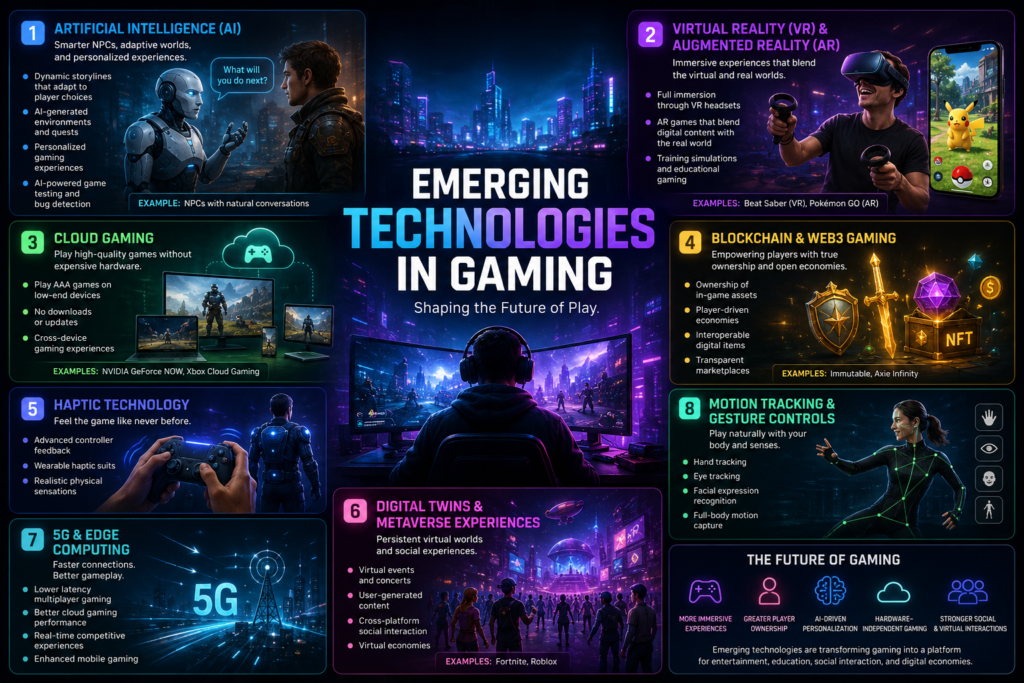
1. Artificial Intelligence (AI)
AI is changing gaming beyond just smarter NPCs.
- Dynamic storylines that adapt to player choices
- AI-generated game environments and quests
- Personalized gaming experiences
- AI-powered game testing and bug detection
Example: NPCs that can hold natural conversations instead of following scripted responses.
2. Virtual Reality (VR) and Augmented Reality (AR)
VR and AR are making games more immersive.
- Full immersion through VR headsets
- AR games that blend digital content with the real world
- Training simulations and educational gaming
Examples include Beat Saber and Pokémon GO.
3. Cloud Gaming
Players can stream games without expensive hardware.
- Play AAA games on low-end devices
- Reduced need for downloads and updates
- Cross-device gaming experiences
Examples include services from NVIDIA GeForce NOW and Xbox Cloud Gaming.
4. Blockchain and Web3 Gaming
Blockchain technology introduces digital ownership.
- Ownership of in-game assets
- Player-driven economies
- Interoperable digital items
- Transparent marketplaces
Examples include games built on networks such as Immutable and Sky Mavis.
5. Haptic Technology
Gaming is becoming more tactile.
- Advanced controller feedback
- Wearable haptic suits
- More realistic physical sensations
Players can feel impacts, movement, and environmental effects in games.
6. Digital Twins and Metaverse Experiences
Virtual worlds are becoming persistent social spaces.
- Virtual events and concerts
- User-generated content
- Cross-platform social interaction
- Virtual economies
Examples include Fortnite and Roblox.
7. 5G and Edge Computing
Faster internet enables:
- Lower latency multiplayer gaming
- Better cloud gaming performance
- Real-time competitive experiences
- Enhanced mobile gaming
8. Motion Tracking and Gesture Controls
Players can interact naturally through body movements.
- Hand tracking
- Eye tracking
- Facial expression recognition
- Full-body motion capture
Why It Matters
The future of gaming is moving toward:
- More immersive experiences
- Greater player ownership
- AI-driven personalization
- Hardware-independent gaming
- Stronger social and virtual interactions
These technologies are not just changing how games are played; they’re transforming gaming into a platform for entertainment, education, social interaction, and digital economies.